


How Do I Know If I Should See a Chiropractor?

One of the things that still surprises me after more than twenty years in practice is how many people assume they only need to see a chiropractor once they're in significant pain.
In reality, many of the people I see tell me afterwards that their body had been trying to get their attention for months—or even years—before they finally booked an appointment.
Which raises an important question...
How do you actually know when it's time to see a chiropractor?
Most people think chiropractic is only for back pain.
In reality, chiropractic is about assessing how well your spine is functioning and whether it may be affecting the way your nervous system communicates with the rest of your body.
The challenge is that spinal dysfunction doesn't always produce obvious symptoms.
That's why I often compare chiropractic to visiting the dentist.
Most people don't wait until every tooth hurts before having a dental check-up.
They understand that prevention and early detection are important.
I believe the same principle applies to your spine and nervous system.
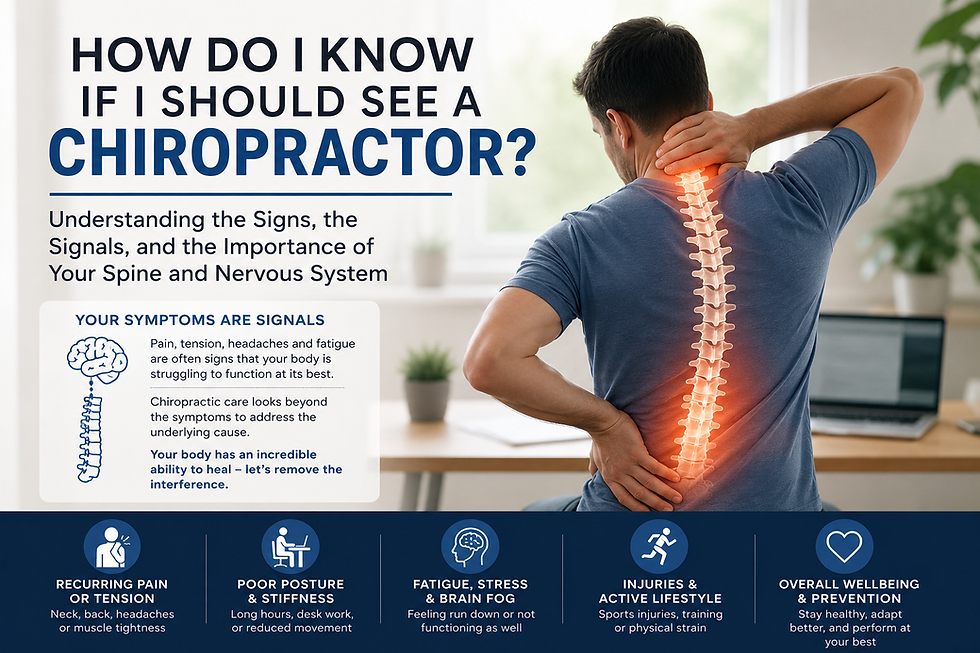
Symptoms Are Signals
If there is one lesson I hope people remember from this article, it is this:
Symptoms are signals.
They are your body's way of saying:
"I'm coping... but it's becoming harder to cope."
Instead of immediately asking,
"How do I get rid of this symptom?"
I encourage patients to ask a different question:
"Why has my body started sending this signal?"
That simple shift in thinking can completely change the way you approach your health.
Common Signs That It May Be Time To See A Chiropractor
Although I believe everyone can benefit from having their spine and nervous system assessed at some stage, there are certain signs that often suggest it's worth having an examination.
Physical signs
recurring headaches
neck pain
back pain
shoulder tension
jaw tension
pain into the arms or legs
Functional changes
stiffness
reduced movement
feeling "out of alignment"
recurring sporting injuries
General health changes
fatigue
difficulty concentrating
reduced resilience
feeling run down
These symptoms don't automatically mean you need chiropractic care.
They simply mean your body deserves a proper assessment.
The Biggest Misconception I See Every Week
One of the biggest misconceptions I hear is:
"I thought chiropractors only treated back pain."
Once people understand the relationship between the spine and the nervous system, they often realise chiropractic is much broader than they expected.
Another common misconception is that you need a referral from your doctor.
You don't.
Chiropractors are primary healthcare practitioners, which means you can make an appointment directly.
People are also often surprised that modern chiropractic care is gentle and highly individualised.
Another concern I hear relates to safety.
In my experience, much of this concern comes from misunderstanding what modern chiropractic care actually involves.
A thorough examination always comes before any treatment, and recommendations are based on your individual findings. If chiropractic isn't appropriate, you should be guided toward the care that is.
Most Problems Don't Start Overnight
One of the patterns I've noticed after seeing thousands of patients is that very few problems begin with one single event.
Someone might tell me,
"My neck has only been bad for the last three weeks."
But when we unpack their history, we often discover:
recurring headaches for years
long hours at a computer
previous sporting injuries
ongoing emotional stress
poor movement habits
persistent muscle tension
The body has simply adapted over time.
What feels like a recent problem is often the accumulation of months or years of physical, emotional and lifestyle stress.
Just because something has become normal doesn't mean it's optimal.
A Story I'll Never Forget
I remember one patient who came to see me because she was getting what she described as "the normal amount of headaches."
As we spoke, it became clear that she was experiencing headaches almost every week.
Taking painkillers had become part of her routine.
She carried them in her handbag everywhere she went.
The headaches weren't just affecting her health.
By the end of each workday she was exhausted.
She had little patience left for her family.
She wanted to spend time with her husband and children but often just wanted to be alone.
That consultation reminded both of us of something important.
Pain is rarely just about pain.
The real cost of pain is what it quietly takes away from your life.
Your energy.
Your patience.
Your relationships.
Your confidence.
Your ability to enjoy the people and activities you love.
What Happens During Your First Visit?
Many patients tell me afterwards,
"I didn't realise the examination would be so thorough."
A first consultation includes a detailed discussion about your symptoms and your health history.
We look beyond where it hurts.
We assess posture, spinal movement, functional movement patterns, neurological function and orthopaedic findings.
When clinically appropriate, we may also perform digital posture analysis or request imaging such as X-rays.
Only once we've gathered all the information do we decide whether chiropractic care is appropriate and what recommendations best suit your goals.
There is no one-size-fits-all approach.
One Lesson Twenty Years Has Taught Me
After helping thousands of people, I've noticed something remarkably consistent.
The people who experience the best long-term results understand that health isn't built overnight.
They don't look for a quick fix.
They understand that meaningful recovery requires:
time
consistency
healthier habits
addressing the factors that contributed to the problem
Once people begin to experience the benefits of moving better, functioning better and feeling better, those healthy habits become easier to maintain.
One Question I Wish More People Asked
Instead of asking,
"How do I get rid of this pain?"
I wish more people would ask,
"Why do these symptoms keep coming back?"
That question changes everything.
It shifts the focus from managing symptoms to understanding why they developed in the first place.
Often, that's where lasting improvements begin.
Understanding How Chiropractic May Help
One of the questions I hear most often after someone decides to book an appointment is how chiropractic actually helps back pain. If you've ever wondered how improving spinal movement may influence muscle tension, posture and the way your nervous system functions, I've written a detailed article explaining the science in simple language.
My Final Thought
If you're considering seeing a chiropractor, my advice is simple.
If you're looking to improve your health naturally and you'd like a better understanding of how your body is functioning, having your spine and nervous system assessed is an excellent place to start.
Even if chiropractic isn't the right solution for you, a good chiropractor should explain why and help guide you toward the most appropriate care.
Your symptoms are not your enemy.
More often than not...
They're your body's way of asking you to pay attention.
Frequently Asked Questions
How do I know if I should see a chiropractor?
If you have recurring pain, headaches, stiffness, reduced movement or simply feel your body isn't functioning as well as it should, a chiropractic assessment may help identify whether spinal dysfunction is contributing.
Do I need a doctor's referral to see a chiropractor?
No. Chiropractors are primary healthcare practitioners, so you can book directly without a referral.
Can I see a chiropractor even if I'm not in pain?
Yes. Many people choose to have their spine and nervous system assessed before symptoms become severe, much like routine dental check-ups.
What happens at my first chiropractic appointment?
Your first visit typically includes a detailed health history, physical examination, posture assessment, neurological and orthopaedic testing, and recommendations based on your findings.
Are chiropractic adjustments safe?
Modern chiropractic care begins with a thorough assessment to determine whether treatment is appropriate. Care should always be tailored to the individual, and if chiropractic is not the right option, you should be guided towards more suitable care


Comments